How Grind Size Affects Taste (And How to Fix Bad Coffee)
Bad coffee usually comes down to grind size. Too fine, and it's bitter. Too coarse, and it's sour. Here's how grind size actually affects taste—and how to fix the coffee you're making right now.
Bad coffee usually comes down to grind size.
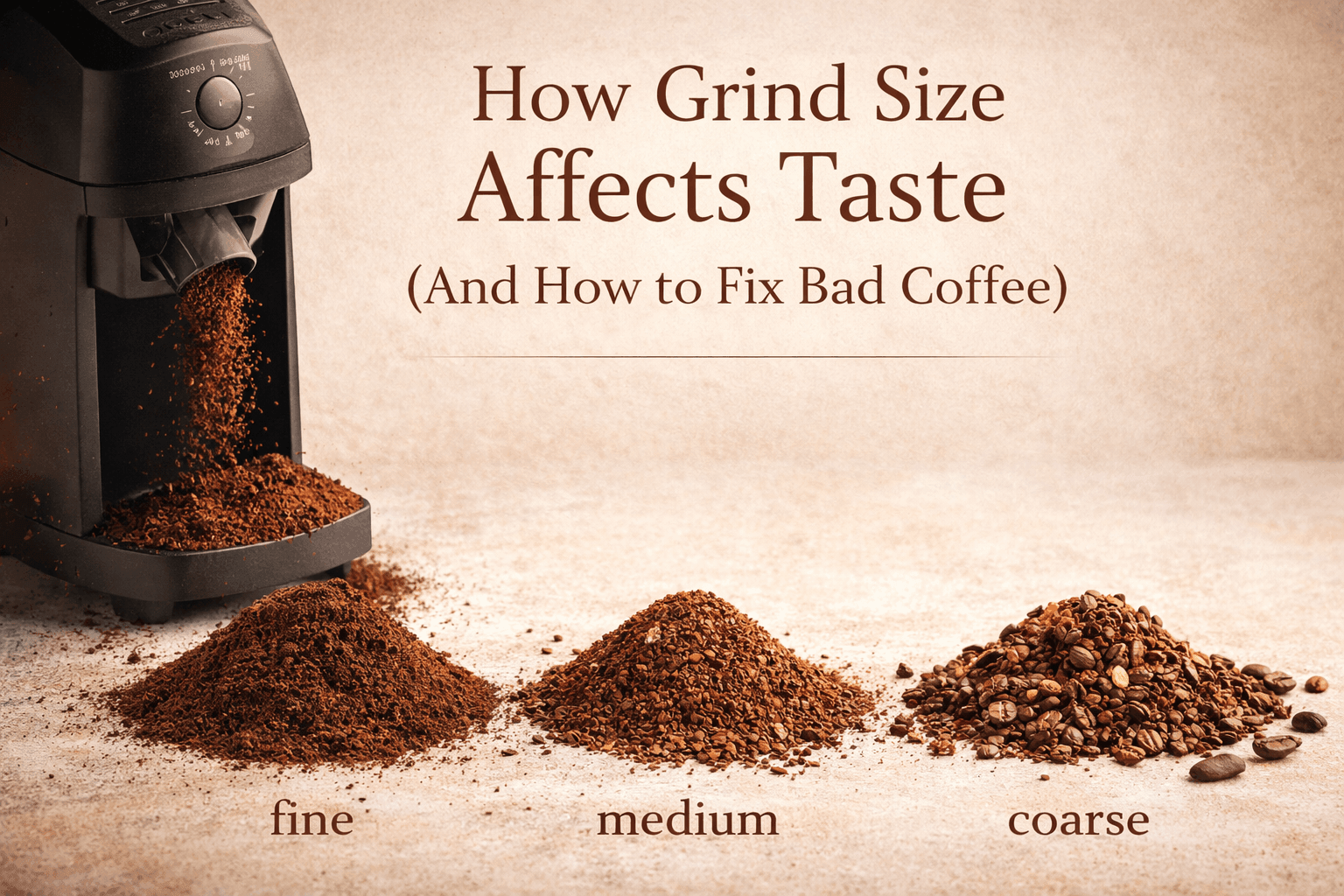
Too fine, and your coffee tastes bitter and over-extracted. Too coarse, and it tastes sour and under-extracted. The difference between good coffee and bad coffee is often just a few clicks on your grinder.
Understanding how grind size affects taste helps you diagnose problems and fix them. You don't need expensive equipment or complicated techniques. You just need the right grind size for your brewing method.
TL;DR: Bitter coffee = grind too fine. Sour coffee = grind too coarse. Adjust grind size before changing anything else.
Why grind size matters
Grind size determines how much surface area coffee exposes to water. This changes how quickly and completely extraction happens.
Think of it like this: whole coffee beans won't extract in four minutes. Ground coffee will. The finer you grind, the more surface area you create, and the faster extraction happens.
This is why different brewing methods need different grind sizes. A French press needs coarse grounds because it steeps for four minutes. A V60 needs medium-fine grounds because water flows through in three minutes. An espresso machine needs fine grounds because water passes through in 30 seconds.
Get the grind size wrong, and you'll taste it immediately.
How grind size affects extraction
Extraction is what happens when water dissolves compounds from coffee grounds. The goal is to extract the good stuff—sweetness, acidity, flavor notes—without extracting the bad stuff—bitterness, astringency, harshness.
Grind size controls the speed of extraction.
Fine grounds: More surface area. Water extracts compounds quickly. This is good for fast brewing methods like espresso. But for slower methods like French press, fine grounds over-extract. You get bitterness and harshness.
Coarse grounds: Less surface area. Water extracts compounds slowly. This is good for slow brewing methods like French press. But for fast methods like espresso, coarse grounds under-extract. You get sourness and weak flavor.
Medium grounds: Balanced surface area. Water extracts at a moderate speed. This works for most pour-over methods like V60 and AeroPress.
The trick is matching grind size to contact time. Fast methods need fine grounds. Slow methods need coarse grounds. Medium-speed methods need medium grounds.
Too fine: bitter and over-extracted
If your coffee tastes bitter, harsh, or astringent, your grind is probably too fine.
Fine grounds extract too quickly. Water pulls out bitter compounds before you can stop it. The result is coffee that tastes like burnt rubber or medicine.
How to recognize it
- Bitter, harsh taste
- Dry, astringent mouthfeel
- Burnt or ashy flavors
- Coffee feels heavy and unpleasant
How to fix it
Make your grind coarser. If you're using a burr grinder, move the setting 2–3 clicks coarser. If you're using a blade grinder, pulse it less. If you're buying pre-ground coffee, ask for a coarser grind.
Then brew again with the same method and ratio. The bitterness should decrease.
If you're using a V60, fine grounds also cause clogging. The water can't flow through, so it sits on the coffee too long. This makes over-extraction worse. Coarser grounds let water flow properly.
If you're using a French press, fine grounds create sludge at the bottom. The metal filter can't catch all the fine particles. Coarser grounds prevent this.
Too coarse: sour and under-extracted
If your coffee tastes sour, weak, or thin, your grind is probably too coarse.
Coarse grounds extract too slowly. Water doesn't have enough time to pull out the good compounds. The result is coffee that tastes like lemon juice or vinegar.
How to recognize it
- Sour, acidic taste
- Weak, thin body
- Missing sweetness
- Coffee feels watery
How to fix it
Make your grind finer. If you're using a burr grinder, move the setting 2–3 clicks finer. If you're using a blade grinder, pulse it more. If you're buying pre-ground coffee, ask for a finer grind.
Then brew again with the same method and ratio. The sourness should decrease, and you should get more flavor.
If you're using a V60, coarse grounds let water flow through too quickly. The coffee doesn't have enough contact time. Finer grounds slow the flow and increase extraction.
If you're using an AeroPress, coarse grounds extract too slowly in the short steep time. Finer grounds extract more completely in 1–2 minutes.
The right grind size for each method
Different brewing methods need different grind sizes. Here's what works for each:
French press: coarse
French press needs coarse grounds because it steeps for four minutes. Fine grounds would over-extract in that time.
Think sea salt or breadcrumbs. The grounds should be large enough that water flows through them easily when you press.
If you're getting sludge or bitterness, your grind is too fine. Make it coarser.
For a complete guide, see our Best French Press Guide 2025.
V60: medium-fine
V60 needs medium-fine grounds because water flows through in about three minutes. Too fine, and it clogs. Too coarse, and it flows through too quickly.
Think table salt or sand. The grounds should be fine enough to slow water flow but coarse enough to prevent clogging.
If you're getting bitterness or clogging, your grind is too fine. If you're getting sourness or fast flow, your grind is too coarse.
For a complete guide, see our V60 Basics article.
AeroPress: medium-fine to fine
AeroPress needs medium-fine to fine grounds because it steeps for 1–2 minutes and uses gentle pressure. The grind can be slightly finer than V60 because the contact time is shorter.
Think slightly finer than table salt. The grounds should extract quickly but not so fine that pressing becomes difficult.
If you're getting bitterness or difficulty pressing, your grind is too fine. If you're getting sourness or weak flavor, your grind is too coarse.
For a complete guide, see our AeroPress Guide 2026 article.
Espresso: fine
Espresso needs fine grounds because water passes through in 20–30 seconds. The grind needs to be fine enough to create resistance and slow the flow.
Think powdered sugar or flour. The grounds should be very fine, almost powdery.
Espresso grind is too specialized for most home setups. If you're making espresso, you need a grinder that can dial in precisely.
Cold brew: coarse
Cold brew needs very coarse grounds because it steeps for 12–24 hours. Fine grounds would over-extract in that time.
Think coarse sea salt or small pebbles. The grounds should be large enough to filter out easily.
How to choose the right grind size
Start with the recommended grind size for your brewing method. Then adjust based on taste.
The adjustment process
- Brew with the recommended grind size.
- Taste the coffee.
- If it's bitter, make the grind coarser.
- If it's sour, make the grind finer.
- Repeat until it tastes balanced.
This is called dialing in. It takes a few cups, but it's the only way to get the grind size right for your specific setup.
Why your grinder matters
A good grinder produces consistent grounds. An inconsistent grinder produces a mix of fine and coarse particles. This makes it impossible to dial in properly.
If you're using a blade grinder, you'll get inconsistent grounds. Some particles will be fine, some will be coarse. This leads to both over-extraction and under-extraction in the same cup.
If you're using a burr grinder, you'll get consistent grounds. All particles will be roughly the same size. This makes dialing in possible.
If you're struggling to dial this in consistently, a basic burr grinder makes this much easier. Even an entry-level one is a big upgrade over blade grinders. For most people, a budget burr grinder is the first real upgrade that matters. It's not cheap, but it makes everything else work better.
When to adjust grind size
Adjust grind size when:
- Your coffee tastes bitter or sour
- Your brewing time is too fast or too slow
- Your coffee tastes weak or harsh
- You've changed coffee beans (different beans extract differently)
Don't adjust grind size when:
- You want stronger or weaker coffee (adjust ratio instead)
- You want different flavor notes (adjust beans or brewing method instead)
- You're trying to fix a different problem (temperature, ratio, technique)
Grind size is about extraction, not strength. Strength comes from ratio—how much coffee you use relative to water.
Common grind size mistakes
Using the same grind for everything
Different brewing methods need different grind sizes. You can't use French press grind for V60, or V60 grind for espresso. Each method has its own requirements.
Keep a mental note of the right grind size for each method you use. Or write it down. It saves time and prevents bad coffee.
Grinding too fine "to make it stronger"
Fine grounds don't make coffee stronger. They make it more extracted, which usually means more bitter. If you want stronger coffee, use more coffee or less water. Don't change the grind size.
Not adjusting when beans change
Different coffee beans extract differently. Light roasts extract slower than dark roasts. Dense beans extract slower than less dense beans. You might need to adjust grind size when you change beans.
Start with the recommended grind size for your method, then adjust based on taste.
Using pre-ground coffee that's wrong for your method
Pre-ground coffee is usually ground for automatic drip machines. This is medium-fine, which works for V60 and AeroPress but is too fine for French press and too coarse for espresso.
If you're using pre-ground coffee, make sure it matches your brewing method. Or buy whole beans and grind them yourself.
The bottom line
Grind size is the most important variable in coffee brewing. Get it right, and your coffee will taste balanced. Get it wrong, and you'll taste it immediately.
Too fine = bitter, over-extracted coffee
Too coarse = sour, under-extracted coffee
Just right = balanced, flavorful coffee
The right grind size depends on your brewing method. French press needs coarse. V60 needs medium-fine. AeroPress needs medium-fine to fine. Match the grind to the contact time.
If your coffee tastes bad, check the grind size first. It's usually the problem. Adjust it, brew again, and taste. Repeat until it's balanced.
A good grinder makes this easier. Consistent grounds are easier to dial in than inconsistent grounds. But you can make good coffee with any grinder if you understand how to adjust.
Coffee brewing isn't complicated. But grind size matters more than most people realize. Get it right, and everything else becomes easier.